Article
Apr 25, 2025
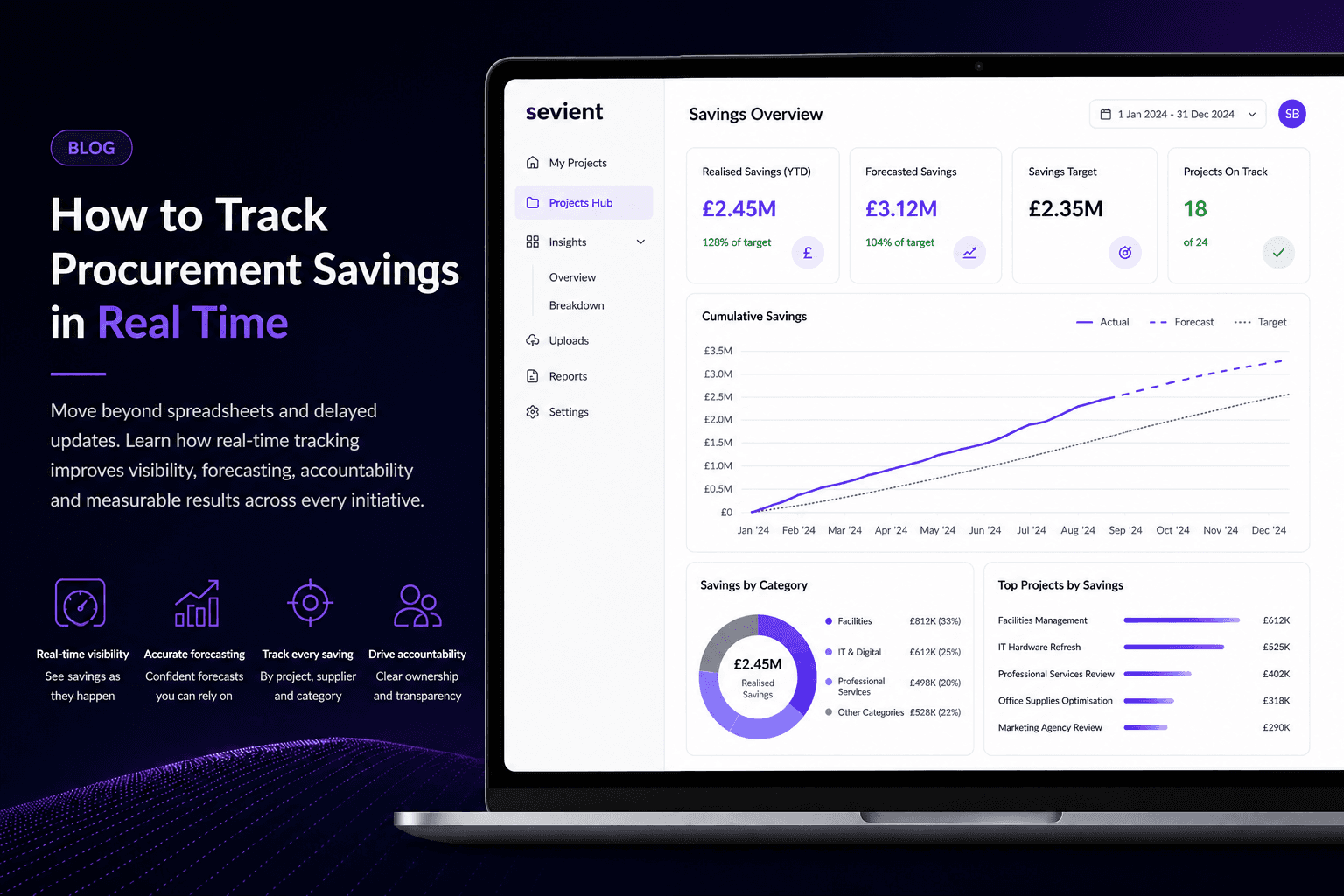
Move beyond spreadsheets and delayed updates. Learn how real-time procurement savings tracking improves visibility, forecasting, accountability, and measurable results across every initiative.
Introduction
Procurement teams are under more pressure than ever to deliver measurable savings, control spend, and prove impact. Yet many organisations still rely on spreadsheets, delayed reporting, and fragmented data sources to monitor performance. By the time issues are identified, opportunities have often been missed.
Real-time procurement savings tracking changes that. Instead of waiting for month-end updates, leaders gain live visibility into performance, forecast delivery more accurately, and hold initiatives accountable as they happen.
In this article, we explore why real-time tracking matters, what it should include, and how modern teams use it to drive better results.
Why Traditional Savings Tracking Falls Short
Many savings programmes start with strong intentions but lose momentum because reporting methods are outdated.
Common challenges include:
Savings tracked manually across multiple spreadsheets
Delayed updates that hide underperformance
No single source of truth across projects
Weak ownership and unclear accountability
Difficulties proving delivered value to finance teams
Limited ability to forecast year-end outcomes
The result is simple: leadership lacks confidence in reported savings, and teams spend more time explaining numbers than improving them.
What Real-Time Procurement Savings Tracking Looks Like
A modern savings tracking system should provide continuous visibility across every active initiative.
Key capabilities include:
1. Live Savings Dashboards
See realised savings as they happen, not weeks later. Dashboards should show:
Total savings delivered
Savings by project
Savings by category
Supplier-level performance
Progress against annual targets
This gives stakeholders instant clarity on what is working and where action is needed.
2. Forecasting and Run-Rate Tracking
Strong teams do not only report the past — they predict the future.
Real-time forecasting helps answer:
Are we on track to hit annual targets?
Which projects are falling behind plan?
What savings are likely by year-end?
Where should leadership focus next?
This turns savings management from reactive reporting into proactive decision-making.
3. Ownership and Accountability
Every initiative should have a clear owner, timeline, and measurable target.
When ownership is visible, teams can quickly see:
Which projects are on track
Which are at risk
Which require intervention
Which are outperforming expectations
Accountability drives execution.
4. Drill-Down Visibility
Senior leaders may want headline numbers, but delivery teams need detail.
The ability to drill into transactions, suppliers, categories, and individual purchase lines helps validate savings and identify blockers quickly.
5. Automated Reporting
Instead of manually rebuilding reports each month, modern systems generate clear board-ready outputs automatically.
That saves time while increasing confidence in the numbers.
The Business Benefits of Real-Time Tracking
Organisations that modernise savings reporting often see benefits beyond procurement.
Faster Decision-Making
Leaders can act immediately instead of waiting for month-end reviews.
Higher Savings Delivery
Problems are identified early, giving teams time to recover underperforming projects.
Stronger Finance Confidence
Transparent methodologies and clear evidence improve trust in reported savings.
Better Team Focus
Less time spent updating spreadsheets means more time negotiating, analysing, and delivering value.
Scalable Governance
As savings programmes grow, automated systems scale far better than manual processes.
What to Measure in Real Time
If you want a high-performing savings programme, track these metrics continuously:
Realised savings
Forecasted savings
Savings vs target
Active projects
At-risk projects
Off-track projects
Category performance
Supplier opportunities
Leakage risks
Last updated activity
These metrics create a complete view of delivery health.
Why Spreadsheets Alone Are No Longer Enough
Spreadsheets can work for a small number of projects, but they struggle when programmes become complex.
As soon as you manage multiple categories, owners, suppliers, timelines, and targets, manual processes become slower, riskier, and harder to trust.
Real-time platforms remove that friction by centralising data and automating visibility.
Final Thoughts
Procurement savings should never be something you discover after the fact. The most effective teams track performance in real time, forecast with confidence, and act quickly when delivery slips.
In a market where every pound matters, visibility is no longer a luxury — it is a competitive advantage.
The future of procurement savings is live, intelligent, and measurable.