Article
Sep 30, 2025
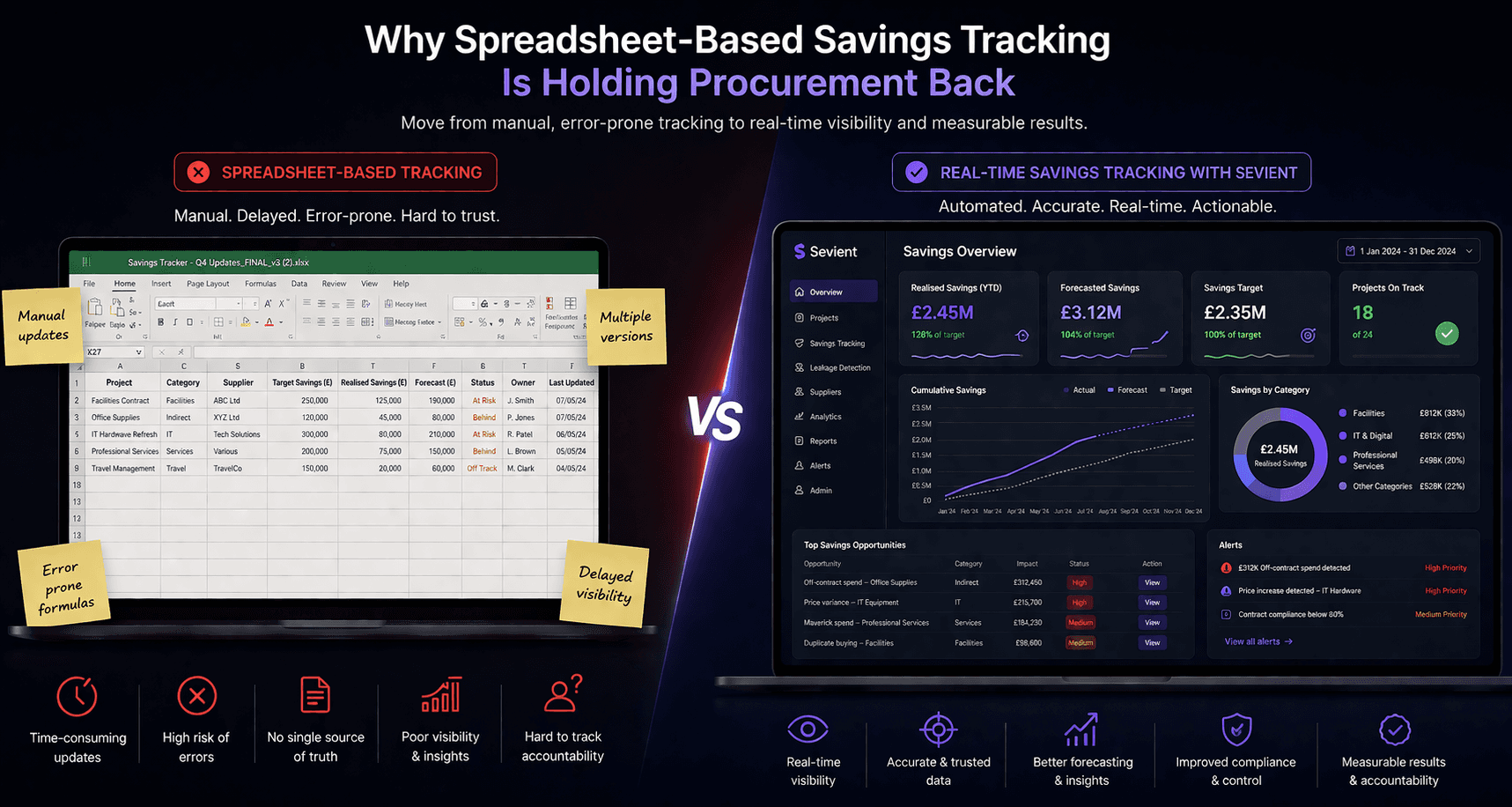
Spreadsheets may feel familiar, but they create delays, errors, and limited visibility. Discover why leading procurement teams are replacing manual tracking with real-time systems.
Introduction
For years, spreadsheets have been the default tool for procurement savings tracking. They are familiar, flexible, and available in every organisation. Many teams still use them to record initiatives, track savings pipelines, monitor delivery, and report progress to leadership.
At first glance, this seems practical.
But as procurement programmes become more complex, spreadsheet-based tracking starts to create more problems than it solves.
What works for a handful of projects quickly becomes difficult to manage across multiple categories, stakeholders, suppliers, sites, and financial periods. Updates become slower, confidence in the numbers drops, and valuable time is spent maintaining files instead of delivering results.
The issue is not that spreadsheets are bad tools. The issue is that they were never designed to run modern savings programmes at scale.
Why Spreadsheets Became the Default
There is a reason spreadsheets remain common.
They are:
Easy to start with
Low cost
Highly flexible
Familiar to every team
Quick for ad-hoc analysis
Useful for one-off reporting
For small teams with a limited number of initiatives, spreadsheets can work reasonably well.
The challenge begins when procurement needs live visibility, cross-functional alignment, reliable forecasting, and executive-grade reporting.
That is where manual tracking starts to break down.
The Real Problems with Spreadsheet-Based Savings Tracking
1. Data Is Outdated the Moment It Is Shared
Most spreadsheet reporting depends on manual updates.
Someone exports data, checks formulas, copies figures into a tracker, updates commentary, saves a new version, and circulates it to stakeholders.
By the time leadership receives the report, the underlying position may already have changed.
Projects may have slipped. New savings may have landed. Risks may have emerged.
When reporting is delayed, decisions are delayed too.
2. Too Much Time Is Spent Maintaining Files
Many procurement professionals spend hours every month updating trackers rather than driving value.
Common manual tasks include:
Chasing project owners for updates
Copying data from ERP reports
Checking broken formulas
Reconciling different versions
Reformatting leadership packs
Rebuilding charts each month
This is low-value admin effort that adds little strategic impact.
The more time spent maintaining spreadsheets, the less time available for sourcing, supplier management, stakeholder engagement, and opportunity delivery.
3. Version Control Becomes a Constant Problem
How many savings trackers exist right now?
One on SharePoint. One emailed last week. One saved locally. One edited by finance. One used in the board pack.
This is a common reality.
When multiple versions exist, teams waste time debating which file is correct instead of focusing on performance. Even small inconsistencies can damage confidence in reported results.
Without a single source of truth, trust becomes harder to maintain.
4. Forecasting Is Weak and Reactive
Strong procurement leadership is not only about reporting savings delivered. It is about knowing whether future targets will be achieved.
Spreadsheet forecasting is often static and manually adjusted. It depends on assumptions buried in cells, formulas few people understand, and updates that happen too infrequently.
That makes it difficult to answer critical questions such as:
Are we on track for year-end targets?
Which projects need intervention now?
What shortfall is emerging?
Where can we recover performance?
Without reliable forecasting, leadership is managing blind.
5. Accountability Is Harder to Enforce
Savings programmes often involve multiple owners across different categories and business units.
In spreadsheets, ownership can become unclear or outdated.
Projects may remain marked green despite inactivity. Risks may go unchallenged. Deadlines can pass without visibility.
Modern delivery requires transparent ownership, clear status, and visible progress.
If accountability lives in hidden rows of a spreadsheet, momentum suffers.
6. Errors Undermine Credibility
Spreadsheets are powerful, but they are fragile.
One broken formula, one overwritten cell, one missing filter, or one accidental copy-paste can materially change reported savings.
Even if the overall work is strong, visible errors reduce confidence fast.
For finance leaders and executives, confidence in the methodology matters as much as the number itself.
If stakeholders doubt the data, procurement spends time defending reports instead of influencing decisions.
7. Insight Is Limited
Spreadsheets can store numbers, but they are weaker at surfacing patterns and actions.
Modern teams need to know:
Which categories are underperforming
Where leakage is increasing
Which suppliers present opportunities
Which projects are at risk
Where savings are accelerating
What should happen next
Static trackers often show what happened. They rarely show what requires action.
That difference matters.
The Hidden Cost of Staying Manual
The cost of spreadsheet dependence is not just inconvenience.
It can lead to:
Missed savings opportunities
Slower decisions
Reduced stakeholder confidence
Poorer forecasting
Weak accountability
Higher admin burden
Less strategic time for procurement teams
Lower overall programme performance
These costs compound over time.
What High-Performing Teams Do Instead
Leading procurement functions are replacing manual trackers with connected, real-time systems.
They use platforms that automatically combine project data, spend data, ownership, targets, forecasts, and reporting in one place.
That enables:
Live savings dashboards
Real-time project status
Forecast vs target visibility
Clear ownership and accountability
Faster board reporting
Better finance confidence
Less manual admin
Stronger decision-making
Instead of managing files, teams manage outcomes.
How Sevient Helps
Sevient helps procurement teams move beyond spreadsheets and run savings programmes with greater control and confidence.
With Sevient, teams can:
Track savings in real time
Monitor delivery across all initiatives
Forecast year-end outcomes
Surface risks early
Generate leadership-ready reporting
Strengthen trust with finance
Reduce manual admin effort
The result is a more visible, measurable, and scalable procurement function.
Final Thoughts
Spreadsheets were never the problem. They were simply the best available option for another era.
But procurement expectations have changed.
Today’s teams are expected to deliver measurable value, respond quickly, forecast accurately, and communicate impact clearly to leadership.
That requires more than rows and formulas.
The teams that modernise savings tracking will not just report better numbers — they will deliver better outcomes.